

act101
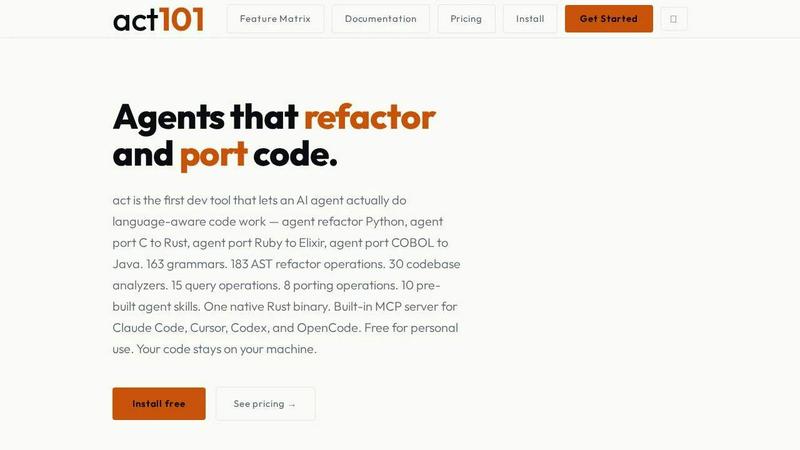
act101 is the AI agent swiss army knife with 163 grammars to refactor and port code in one native Rust binary.
About act101
act101 is the absolute wildest dev tool to hit the scene for AI coding agents. Think of it as the first tool that lets your AI actually do the code work instead of just talking about it. We are talking real refactoring, real porting across 163 languages, all packed into a single native Rust binary. No bloat, no weird dependencies, no supply chain nightmares. It just works.
This thing is a Model Context Protocol (MCP) server, meaning it plugs right into your favorite AI coding sidekicks like Claude Code, Cursor, Codex, and OpenCode. Instead of your AI agent doing a messy whole-file rewrite that destroys your formatting and comments, act101 gives it 183 AST-aware refactor operations. It can extract a function, rename a symbol across an entire workspace, or move a module and update every single import. It has 30 codebase analyzers to sniff out coupling, dead code, and cycles. It even has 8 porting operations to migrate an entire codebase from C to Rust or COBOL to Java. And the best part? Every operation has an automatic checkpoint with instant undo. Your code stays on your machine, no telemetry, no indexing, no cold start. It is free for personal use, and it is a total game changer for anyone who wants their AI agent to stop yapping and start shipping.
Features of act101
183 AST Refactor Operations
This is the bread and butter. Instead of your AI agent rewriting a whole file and hoping for the best, act101 gives it 183 typed, AST-aware operations. We are talking extract-function, rename, move-symbol, inline, convert-to-dataclass, extract-trait, add-type-hints, organize-imports, and 177 more. Every operation works across your entire codebase with cross-file consistency. The agent makes a change, and you get an automatic checkpoint. If something looks sus, you hit undo instantly. No more losing comments, breaking formatting, or dealing with broken code.
30 Codebase Analyzers
Before your AI agent even touches a line of code, act101 can give it a full structural map of your repo. These 30 analyzers cover everything: cohesion, coupling, cycles, chokepoints, hotspots, dead code, layers, seams, clusters, surface area, fan balance, migration readiness, and type completeness. The agent gets the full picture of what is broken, what is tangled, and what is safe to touch. It is like giving your AI X-ray vision for your codebase.
8 Porting Operations with State Machine
Porting code between languages has always been a nightmare, but act101 makes it a structured, step-by-step process. The agent uses port_contract to anchor the source-to-target migration, port_inventory to enumerate every symbol that must move, port_order to resolve dependency ordering, and a port_manifest state machine (init, add, update, remove, note) to track progress. This works between any two of the 163 supported grammars. Want to port C to Rust or COBOL to Java? The agent handles it like a pro.
10 Pre-Built Agent Skills
act101 comes with 10 pre-built agent skills that compose all those operations into common engineering workflows. You get architecture-audit, code-review, refactoring, code-navigation, code-generation, migration-assessment, boundary-analysis, change-impact, health-check, and architectural-refactoring. Just invoke them with /skill-name in Claude Code or Cursor, and your AI agent runs a full workflow without you having to micromanage every step.
Use Cases of act101
Refactoring a Messy Python Monolith
You have a massive Python codebase that has been hacked together for years. It is full of copy-pasted functions, weird variable names, and no type hints. With act101, your AI agent can run a full refactoring skill. It uses the analyzers to find dead code and high coupling. Then it calls extract-function to break up those massive functions, rename to fix all those garbage variable names, and add-type-hints to make the whole thing readable. Every change is checkpointed, so if the agent messes up, you just undo and try again.
Porting a C Library to Rust
You have a critical C library that needs to be ported to Rust for memory safety. Instead of manually translating every line, you let act101 handle it. The agent starts with port_contract to define the scope, then uses port_inventory to list every symbol. It resolves dependencies with port_order and then uses the manifest state machine to track the migration step by step. The result is a Rust port that is structurally sound and ready for review, all without you writing a single line of the translation.
Analyzing a Codebase for Migration Readiness
Your team is thinking about moving from Ruby to Elixir, but you have no idea how bad the spaghetti is. Act101 comes in clutch. The agent runs the migration-assessment and boundary-analysis skills. It uses the analyzers to check coupling, cycles, and hotspots. It gives you a full report on which parts of the codebase are easy to port and which are a nightmare. You get a clear roadmap before you commit to the migration, saving your team months of wasted effort.
Performing a Code Review on a Large PR
You have a massive pull request with changes across 50 files. Reviewing it manually would take hours. Instead, you drop it into your AI agent with act101. The agent runs the code-review skill. It uses the analyzers to check for dead code, high coupling, and potential cycles introduced by the changes. It calls rename and move-symbol operations to verify consistency. It gives you a structured report of what is good, what is bad, and what needs to be fixed, all in minutes.
Frequently Asked Questions
Does act101 send my code to the cloud?
Nope. Your code stays on your machine. Act101 is a local binary that runs on your computer. There is no telemetry, no phone home, and no data collection. The only time it might contact our servers is for license verification, and that is it. Your code is safe.
How is act101 different from just asking an AI to rewrite a file?
When you ask an AI to rewrite a file, it does a whole-file rewrite. That destroys your formatting, loses comments, and breaks your undo history. Act101 uses AST-aware operations. It makes surgical changes like extract-function or rename that preserve everything else. Plus, every operation has an automatic checkpoint with instant undo. It is a completely different level of control.
What AI tools does act101 work with?
Act101 is an MCP server, so it works with any MCP-aware client. That includes Claude Code, Cursor, Windsurf, Codex, and OpenCode. If your AI coding tool supports the Model Context Protocol, act101 plugs right in. No plugins, no runtimes, just a single binary.
Is act101 really free for personal use?
Yes, it is free for personal use. You can download the binary, set it up, and start refactoring and porting your code right now. There is a pricing page for commercial use, but for personal projects, you are good to go. No hidden costs, no limited features.
Pricing of act101
Act101 is free for personal use. You can download the binary and use all 183 refactor operations, 30 analyzers, 8 porting operations, and 10 pre-built agent skills without paying a dime. There is a pricing page for commercial and team use, but for your own projects, it is completely free. No trial period, no limited features, no catches.
Similar to act101


Luminus Tools
A fast, privacy-first suite of online calculators, financial desks, health trackers, and developer utilities running completely in your browser withou

Sprite Sheet Maker
A free browser-based toolkit for creating, cutting, converting, and previewing sprite sheet animations.

Forms Plugin
The #1 Native Form Builder Plugin for Framer - No Code, No Embeds, No External Platforms.


