

Capri Ai Agentpay
Capri AgentPay lets your AI agents pay APIs on their own with budgets, approvals, and receipts so you don't have to hand out keys.
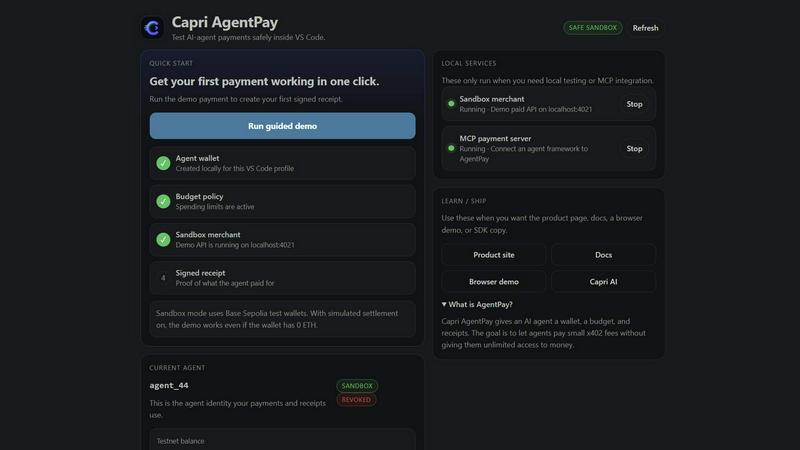
About Capri Ai Agentpay
Alright, let's cut the corporate nonsense. Capri Ai Agentpay is basically the bouncer your AI agents desperately need before they touch any real money. You know that nightmare scenario where your agent, hyped up on a bad prompt, decides to drain your entire crypto wallet on some sketchy API call? Yeah, AgentPay stops that cold. It's a governed payment layer that sits right between your agent and the actual signing key. Think of it as a runtime security guard that says "hold up, let me check the rules first" before any transaction goes through.
When your agent hits an HTTP 402 Payment Required challenge, AgentPay doesn't just blindly pay up. It runs your payment through a fixed policy checklist: is this merchant on the allowlist? Is it under the per-transaction cap? Does it fit the daily budget? And if it's over the auto-approve threshold, it pauses and pings a human for a quick review. Only when every single check passes does it actually settle the payment, retry the original request with proof attached, and store a signed receipt you can verify offline. This is built for dev teams shipping agent systems in production who need real controls, not just vibes. It's for the folks at companies like northwind, vela labs, and orbit who were terrified to let their agents near paid APIs but now ship in a week. AgentPay gives you six MCP tools instead of raw key access, a VS Code extension for easy setup, and a Base Sepolia sandbox for testing. Your agents never hold your keys, ever. Every payment is policy-checked before a signature even exists. It's the difference between letting your agent drive your car and giving it a bus pass with a spending limit.
Features of Capri Ai Agentpay
x402 Payment Handling
This is the core magic. When your agent makes a call to a paid API and gets hit with that HTTP 402 "Payment Required" response, AgentPay doesn't freak out. It intercepts the challenge, evaluates your payment policy, and handles the settlement automatically. The agent calls one typed surface, and AgentPay does the rest. It retries the original request with proof of payment attached, so the whole flow feels seamless. No manual intervention needed for routine stuff, just clean, automated payment handling that keeps your agent moving.
Per-Agent Budgets and Caps
You don't want one rogue agent burning through your entire monthly budget on a single API binge. AgentPay lets you set per-transaction caps and daily budgets for each agent individually. So Agent A can have a $10 daily limit while Agent B gets $500, all controlled from a single policy interface. The policy evaluation is fixed order: merchant allowlist, per-transaction cap, daily budget, then the auto-approve threshold. This granular control means you can give agents enough rope to be useful without letting them hang themselves financially.
Merchant Allowlists
Not every API on the internet deserves your money. AgentPay lets you maintain a curated list of approved merchants that your agents are allowed to pay. If an agent tries to send cash to some random endpoint that isn't on the list, the transaction gets denied immediately. This is your first line of defense against prompt injection attacks or agents going off-script. You control exactly which services your agents can spend money on, and anything outside that list is a hard no.
Human-in-the-Loop Approvals
Sometimes an agent needs to make a big purchase, and you want a real human to eyeball it first. AgentPay has an auto-approve threshold that you set. Below that number, payments go through automatically. Above it, the system pauses, sends a notification to the operator with all the details (exact amount, asset, chain, recipient), and waits for a human to click approve or deny. The operator sees exactly which policy branch passed or failed, and gets a receipt object with hashes, timestamps, and verification fields. It's the perfect balance between automation and control.
Use Cases of Capri Ai Agentpay
Automated Research Agent Accessing Premium Data APIs
Imagine you've got an AI research agent that needs to call premium data sources like financial market APIs or scientific databases. These services cost money per call, and you don't want your agent accidentally racking up a $10,000 bill because of a buggy loop. With AgentPay, you set a $50 daily budget and a $5 per-call cap. The agent hits the API, gets a 402 challenge, AgentPay checks the policy, auto-approves the small transaction, and the agent gets its data. If something goes wrong and the agent starts spamming calls, the daily budget kicks in and shuts it down. Your security team sleeps easy knowing every payment was policy-checked.
Internal Tool Orchestration for Enterprise Workflows
Big companies have tons of internal tools and services that cost money to use. Your agent might need to query a paid analytics service, spin up a cloud instance, or pay for a third-party API integration. Handing those agents a private key is a security nightmare waiting to happen. AgentPay puts a governed layer in between. The agent uses MCP tools to make requests, and each payment goes through the policy gauntlet. The operator gets a clear review queue and audit trail, so they know exactly what the agent is spending and where. It turns a chaotic free-for-all into a managed, auditable process.
DeFi Trading Bots with Spending Limits
You've got a trading bot that needs to execute transactions on-chain, but you're not about to give it unrestricted access to your main wallet. AgentPay lets you set strict per-transaction caps and daily budgets for the bot. It uses the Base Sepolia sandbox for testing first, then when you're ready for mainnet, the same policies apply. The bot hits a paid API for price data, gets a 402 challenge, and AgentPay handles the settlement with signed receipts you can verify offline. If the bot goes haywire and tries to spend more than the cap, the human-in-the-loop approval kicks in. It's the difference between letting your bot trade and letting it gamble with your life savings.
Freelance AI Agent Platforms with Client Budgets
If you're running a platform where clients deploy their own AI agents, you need a way to manage spending across multiple users. AgentPay gives you per-agent budgets and caps that you can assign to each client's agent. Client A gets a $100 monthly budget with a $10 per-transaction cap, while Client B gets $500 with a $50 cap. The policy engine handles it all automatically. When an agent hits a paid API, it checks the client's policy, settles the payment, and stores a verifiable receipt. Your clients get transparency into what their agents are spending, and you get the peace of mind that no single agent can blow past their budget.
Frequently Asked Questions
How does AgentPay prevent my agent from draining my wallet?
AgentPay puts a runtime between your agent and the signing key. Your agent never holds a private key directly. Instead, it makes requests through a typed surface that goes through a fixed policy evaluation: merchant allowlist, per-transaction cap, daily budget, and an auto-approve threshold. If any of those checks fail, the transaction doesn't happen. Even if an attacker compromises your agent's prompt, they can't drain your wallet because the key is locked behind the policy gate.
What happens when a payment exceeds the auto-approve threshold?
When a payment goes over the auto-approve threshold you set, AgentPay pauses the transaction and sends a notification to the operator. The operator sees the exact amount, asset, chain, and recipient, along with which policy branch passed or failed. They can click to approve or deny the request. If approved, the payment settles, the original request is retried with proof attached, and a signed receipt is stored. If denied, the transaction is blocked.
Can I use AgentPay with any blockchain or only Base Sepolia?
AgentPay currently supports settlement on Base Sepolia for testing and sandbox environments. The documentation mentions deployment notes for this exact build, and the product is designed to be extensible. The core architecture with x402 handling, policy evaluation, and signed receipts is chain-agnostic, but you'll want to check the docs for the latest supported chains and deployment options.
How do I set up AgentPay for my existing agent system?
You start by installing the VS Code extension and requesting access through the Capri AI website. The quickstart guide walks you through setting up your first policy, defining merchant allowlists, and configuring per-agent budgets. You get six MCP tools instead of raw key access, so your agent interacts with a clean, typed interface. The Base Sepolia sandbox lets you test everything risk-free before going live. The whole setup is designed to go from "scared to let an agent near a paid API" to shipping in a week.
Similar to Capri Ai Agentpay

SightRadar
Face recognition API, a drop-in replacement for AWS Rekognition. Index, search, compare and detect faces, billed per photo with no subscription.

Hishab
All-in-one POS, inventory, accounting and HR software for Bangladeshi SMEs — real-time sales, stock and finance in one place.


SnitchFeed
SnitchFeed is an agentic social listening tool that surfaces high-intent conversations on LinkedIn, X, Hackernews, and more for GTM and product teams.


AIEnhancer
Enhance photos, create images, and generate videos with an all-in-one AI enhancer.

LTX 2.3 Free
LTX 2.3 prompts, workflows, demos, and practical AI video guidance.