
Antigravity AI Directory vs OpenMark AI
Side-by-side comparison to help you choose the right AI tool.

Antigravity AI Directory
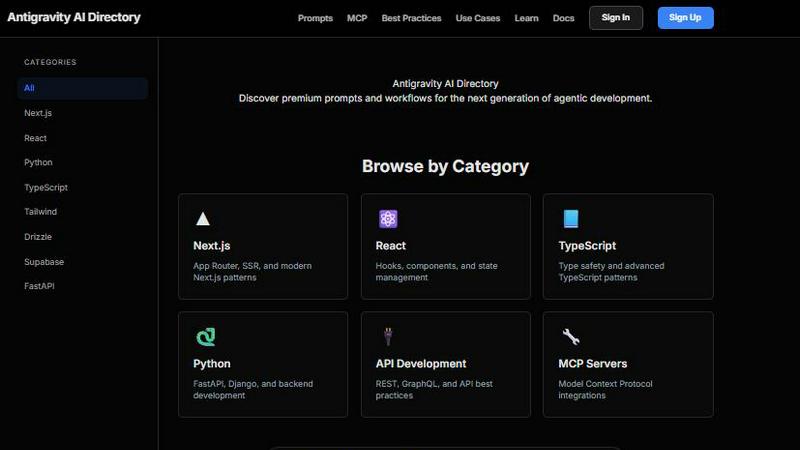
Discover 125+ killer AI prompts and 430+ workflows for Next.js, React, and Python devs, all totally free and ready to.
Last updated: March 1, 2026

Stop guessing which AI model slaps for your task, just describe it and we'll benchmark 100+ models for you in minutes, no API keys needed.
Last updated: March 26, 2026
Visual Comparison
Antigravity AI Directory
OpenMark AI
Feature Comparison
Antigravity AI Directory
Extensive Prompt Library
Dive into a vast collection of over 125 expertly crafted prompts that cater to numerous development needs. Whether you're looking for coding shortcuts, debugging tips, or innovative project ideas, this library has you covered, ensuring you're never short of inspiration.
MCP Server Integrations
With more than 430 MCP servers ready for action, you can integrate popular tools like Supabase, GitHub, and AWS seamlessly into your projects. This feature helps streamline your development process, allowing you to focus on what really matters—building amazing applications.
Easy Navigation
Find what you need in a flash! Our intuitive directory layout lets you browse through various categories like Next.js, React, and Python effortlessly. No more endless scrolling or getting lost—just quick access to the resources and tools you need to accelerate your coding adventures.
Community-Driven Content
Join a thriving community of developers! Contribute your own prompts, share your experiences, and access popular prompts that are trending this week. This collaborative environment not only fosters learning but also keeps you updated on the latest innovations and best practices in AI-assisted development.
OpenMark AI
Plain Language Task Wizard
Forget writing complex code or JSON configs. You just type out what you want the AI to do, like "extract the invoice total and due date from this messy email" or "write a chill marketing tweet for this new feature." OpenMark's wizard takes your vibe and builds the benchmark. It's the ultimate "explain it to me like I'm five" but for setting up professional-grade LLM tests. No PhD in prompt engineering required.
Real API Cost & Latency Showdown
This ain't about theoretical token prices on a spec sheet. OpenMark makes real API calls to every model and shows you the actual receipt—how much that specific request cost and how long it actually took to come back. You can instantly spot the models that give you 95% of the quality for 50% of the price, or the ones that are weirdly slow. It's all about cost efficiency, not just raw cheapness.
Variance & Consistency Scoring
Any model can have a one-hit-wonder output. OpenMark runs your task multiple times for each model to see the variance. You get to see if Model A nails it 9 times out of 10, or if Model B is a complete wildcard that gives you genius one minute and gibberish the next. This stability check is crucial for shipping something you can actually trust in production, not just a cool demo.
Hosted Benchmarking (No Key Drama)
The biggest flex? You don't need to set up individual API keys for OpenAI, Anthropic, Google, etc., just to compare them. You buy OpenMark credits and it handles all the backend API calls across its massive model catalog. It removes the setup hell and lets you focus purely on the results. It's like having a universal remote for every AI model out there.
Use Cases
Antigravity AI Directory
Accelerate Project Launches
Using our extensive library of prompts and MCP integrations, developers can quickly prototype and launch applications. This means you can go from idea to deployment in record time, making it ideal for startups and agile teams.
Enhance Team Collaboration
With community-driven content, your entire team can benefit from shared knowledge. This leads to better collaboration, reduced onboarding time for new developers, and overall improved productivity in project workflows.
Implement Advanced Features
Want to add real-time capabilities or advanced security measures to your app? The Antigravity AI Directory provides the tools and knowledge necessary to implement complex features like GraphQL subscriptions and comprehensive security headers with ease.
Continuous Learning and Improvement
Stay ahead of the curve by accessing our blog packed with the latest trends, tips, and best practices. This feature supports ongoing education, helping developers keep their skills sharp and stay updated on new technologies and methodologies.
OpenMark AI
Pre-Launch Model Selection
You're about to bake an LLM into your app's new support chatbot. Do you go with GPT-4o, Claude 3.5 Sonnet, or a fine-tuned Llama? Instead of debating in Slack, create a benchmark with real user query examples. Run it. In minutes, you'll have data on which model understands your domain best, responds fastest, and keeps your API bill from being absolutely unhinged.
Validating Cost-Efficiency for a Workflow
Your data extraction pipeline uses an expensive top-tier model for every single document. Is that overkill? Use OpenMark to test your extraction prompts against cheaper, smaller models. You might find one that's just as accurate for simple forms, letting you save the big guns for only the complex cases and slashing your monthly costs dramatically.
Checking Output Consistency for Agents
Building a multi-agent system? You need to know if your "reasoning" agent is consistently logical, not just occasionally brilliant. Benchmark the same reasoning task 20 times. OpenMark's variance charts will show you if the agent's output is stable or all over the place, preventing a production nightmare where your agent randomly decides 2+2=5.
Comparing New Model Releases
A new model drops every Tuesday. Does it live up to the marketing for your tasks? Don't just read the blog post. Quickly clone an existing benchmark task in OpenMark, add the new hotness to the lineup, and run a head-to-head. See if it's actually worth switching your integration over to, based on your own real-world criteria.
Overview
About Antigravity AI Directory
Welcome to the Antigravity AI Directory, a cosmic hub where coding meets cutting-edge AI technology! This badass platform is tailored for developers who want to elevate their projects to interstellar heights using the Google Antigravity IDE. Whether you’re a seasoned coder or just starting out, this directory is your key to shipping faster, coding smarter, and building better with the help of AI agents. With over 125 killer prompts and 430+ MCP servers specifically designed for Gemini 3 agentic development, you’ll find everything you need to supercharge your workflow. Navigate effortlessly through categories like Next.js, React, Python, and TypeScript, all while diving into a treasure trove of tips, tricks, and the latest trends via our informative blog. It’s time to unlock the true power of AI and take your development game to the next level!
About OpenMark AI
Alright, let's cut through the AI hype. You're building something cool, you need a brainy LLM to power it, and you're staring down a list of 100+ models like it's a Netflix menu with nothing good. Which one actually works for your thing? Which won't cost an arm and a leg? And will it flake out on you after one good response? That's the chaos OpenMark AI fixes. It's your personal AI model testing arena. You just describe your task in plain English (or any language, really), hit go, and it runs that exact prompt against a ton of different models—GPTs, Claude, Gemini, open-source stuff, you name it—all at once. No juggling a million API keys, no coding a bespoke testing suite. You get back a side-by-side breakdown of who's the real MVP, based on actual cost per API call, speed, scored quality, and—this is the kicker—consistency across multiple runs. So you see if a model is reliably smart or just got lucky once. It's built for devs and product teams who are done guessing and need hard data before they ship. Think of it as due diligence for your AI feature, so you don't end up picking the flashy model that totally bombs on your specific use case.
Frequently Asked Questions
Antigravity AI Directory FAQ
What is the Antigravity AI Directory?
The Antigravity AI Directory is a comprehensive platform designed for developers that offers a collection of AI prompts and MCP server integrations specifically for the Google Antigravity IDE.
How can I contribute to the Antigravity AI Directory?
You can contribute by sharing your own prompts and insights with the community. This collaborative environment encourages developers to help each other grow and learn.
Is there support available for new users?
Absolutely! Our directory includes a blog filled with tutorials, tips, and guides to help new users familiarize themselves with the platform and get the most out of their development experience.
Can I access the Antigravity AI Directory from any device?
Yes! The Antigravity AI Directory is designed to be accessible from any device with an internet connection, allowing you to code and explore resources wherever you are.
OpenMark AI FAQ
Do I need my own API keys to use OpenMark?
Nope, that's the whole vibe! You use OpenMark credits. We handle all the API calls to the different model providers (OpenAI, Anthropic, Google, etc.) on our backend. You just describe your task, pick models from our catalog, and run the benchmark. No key management, no separate bills, no setup friction.
How is this different from reading benchmark leaderboards?
Those public leaderboards test models on generic tasks like trivia or math. OpenMark is for your specific, unique task. It's the difference between reading a car's top speed and actually test-driving it on your commute route. You get results based on your actual prompts, your data, and your definition of "good."
What kind of tasks can I benchmark?
Pretty much anything you'd use an LLM for! Common ones are classification, translation, data extraction, Q&A, summarization, creative writing, code generation, and testing RAG pipelines. If you can describe it, you can probably benchmark it. The platform is built for real-world, task-level testing.
How does the scoring and "variance" thing work?
When you run a benchmark, we execute your prompt multiple times for each model (configurable). We then score each output based on your task's goal. The results show you the average score, but more importantly, they show the spread—like a distribution chart. A tight cluster means the model is consistent. A wide spread means it's unpredictable, which is a huge red flag for production use.
Alternatives
Antigravity AI Directory Alternatives
The Antigravity AI Directory is a cutting-edge resource tailored for developers who want to turbocharge their coding experience with AI prompts and workflows. It falls into the development tools category, focusing on enhancing productivity in environments like Next.js, React, and Python. Users often seek alternatives to meet specific needs or preferences, whether it's due to pricing, unique features, or compatibility with different platforms and tech stacks. When browsing for alternatives, it's crucial to consider factors like the range of available resources, community support, ease of use, and how well the tool integrates with your workflow.
OpenMark AI Alternatives
So you're checking out OpenMark AI, the slick web app that lets you pit a hundred-plus LLMs against your specific task to see who's actually worth the API call. It's a dev tool built for the crucial pre-launch hustle, giving you the real tea on cost, speed, quality, and consistency before you commit code. People scope out alternatives for all the usual reasons. Maybe the pricing model doesn't vibe with your current workflow, or you need a feature that's still on the roadmap. Sometimes you just prefer a different interface or need it to play nicer with your existing tech stack. When you're shopping around, keep your eyes on the prize. You want something that gives you actual, unfiltered results from real API calls, not marketing fluff. The whole point is to nail down the best bang-for-your-buck model for your exact use case, so prioritize tools that deliver transparent, actionable data on performance and stability.