
Patrivox vs Surnex
Side-by-side comparison to help you choose the right AI tool.

Patrivox
Stop wasting hours in dusty archives, let AI read and connect everything so you can search it all in seconds.
Last updated: March 4, 2026

Stop juggling a million SEO tools and get AI search visibility plus your full SEO stack in one slick platform.
Last updated: March 26, 2026
Visual Comparison
Patrivox
Surnex
Feature Comparison
Patrivox
Automation: The "Set It & Forget It" Magic
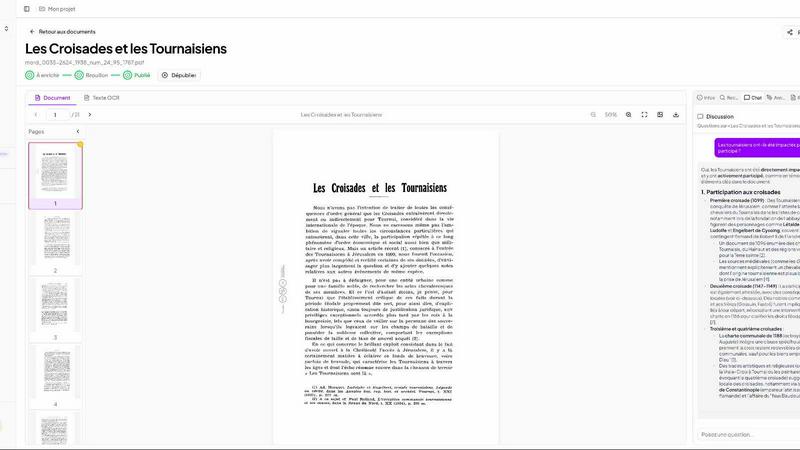
This is the core vibe. You literally drag and drop your PDFs, hundreds at a time if you want. Then, you just vibe while Mistral AI's next-level OCR reads every single page. It automatically pulls out all the important entities (people, places, orgs, dates) and enriches the metadata. Zero manual entry, zero fuss. It's like an autopilot for digitizing your entire collection, making it searchable in minutes, not months.
Search: Your Google for History
Forget Ctrl+F through one doc at a time. This is instant, full-text search across your ENTIRE archive. It's got typo tolerance, so "Tournai" and "Turnai" both get results. You can filter by date, author, or type. The real party trick? The AI chat. Just ask a question in normal language like "Who was involved in the 1830 renovations?" and it'll give you a sourced answer pulled from your docs. Hours of digging become seconds of asking.
Constellation: The Knowledge Graph Flex
This is where it gets visually stunning. The AI doesn't just list entities; it maps how they're connected. Every person, place, and organization becomes a node in an interactive web. You can click on "Cloquet" and see all the documents and other people he's linked to, uncovering hidden relationships you might have totally missed. It's like seeing the secret social network of your archives.
Built for Teams & Trust
Patrivox gets that you need to share this knowledge. You get unlimited readers for free, so you can open access to researchers, your team, or the public without breaking the bank. Multiple admins can manage it. Plus, the whole sovereignty thing is a major key: 100% hosted in Europe, designed for GDPR from the ground up, with audit logs. Your data stays yours, safe and sound on this side of the pond.
Surnex
AI Visibility Tracking
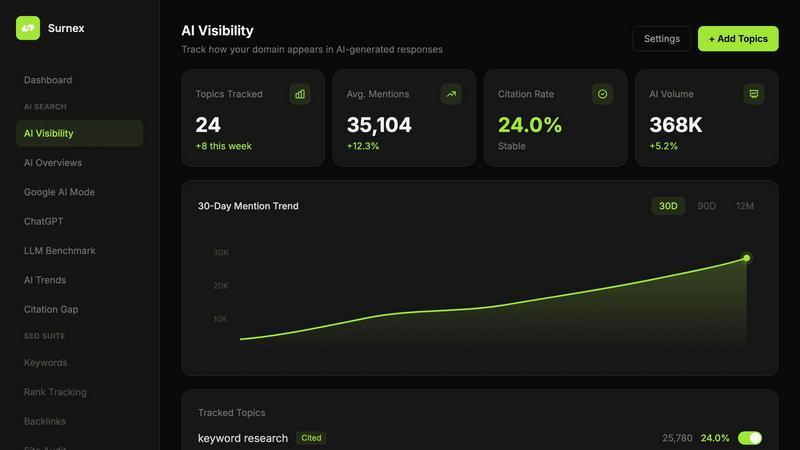
This is the flagship feature, the big kahuna. Surnex lets you spy on all the major AI players - ChatGPT, Google AI Overviews, Perplexity, Claude, you name it. See exactly where your brand gets mentioned (or, oof, where it doesn't) in those slick AI-generated answers. Track your citation rates, watch competitor mentions, and see visibility trends over time. It's like having a backstage pass to the future of search.
Citation Gap Analysis
This is where you go from watching to winning. Surnex doesn't just show you the data; it highlights the gaps. It pinpoints specific queries where your competitors are getting shouted out by AI and you're getting ghosted. It then ranks these opportunities so you know exactly what content or authority gaps to fix first. Turn FOMO into a solid game plan.
Full SEO Toolkit
No more app-hopping. Surnex packs all the classic SEO essentials right inside: keyword tracking, ranking monitoring, backlink analysis, site audits, domain health checks, and Core Web Vitals. Everything you need to keep your website's foundation rock-solid is in one place, saving you from managing four separate, expensive subscriptions.
Built API-First
For the builders and the automators, this is a dream. Every single feature in Surnex is accessible through a clean REST API. Want to build search intelligence into your own product, supercharge your internal research agents, or create automated workflows? Go nuts. It's designed to be plugged into your stack, not just sit in a browser tab.
Use Cases
Patrivox
Municipal Archives Getting Their Act Together
Got decades of town council deliberations, citizen registers, and old correspondence sitting in scanned piles? Patrivox is your digital archivist. Drop those PDFs in, and suddenly every decision, name, and address from 1890 is searchable. Perfect for answering citizen queries fast or prepping for historical research without the manual nightmare.
Historical Societies Unleashing Their Bulletins
Those amazing, niche bulletins and documentary collections your society publishes? They're gold, but only if people can find the info. Patrivox indexes them all, making every article, photo caption, and member mention searchable. Members can finally find that one 1985 article about the local bridge in seconds, boosting engagement and research value big time.
Heritage Libraries Opening the Vault
Special collections are called "special" for a reason, but they're often a pain to access. With Patrivox, you can digitize and index those rare book collections, manuscripts, or photo archives. Researchers can use natural language to explore them, and you can offer a slick public portal without risking the physical copies. Knowledge democratized.
Parishes & Dioceses Preserving the Sacred Stuff
Parish registers, baptismal records, ecclesiastical archives—this is sensitive, precious, and historically vital stuff. Patrivox offers a secure, European-hosted way to preserve it all digitally. Index every name, date, and location automatically, making genealogical research a breeze for families and historians while keeping the original documents safe.
Surnex
Marketing Agency Client Reporting
Agencies, listen up. Stop cobbling together reports from different tools. With Surnex, you can give clients the full picture: their traditional Google rankings AND their visibility across ChatGPT, Perplexity, etc., all in one slick, white-labeled report. It's a huge value-add that makes you look like a genius who's ahead of the curve.
In-House SEO & Content Strategy
Internal teams can use Surnex to get everyone on the same page. Content writers, product marketers, and leadership can all see the dashboard. Use the Citation Gap Analysis to direct your content team's efforts toward topics that actually boost AI visibility, making your work directly tied to emerging search trends.
Competitive Intelligence Deep Dives
Go beyond basic rank tracking. Use the LLM Benchmarking to see how different AIs (Google vs. ChatGPT vs. Claude) answer the same questions and which domains they trust. Uncover why a competitor is dominating AI answers and reverse-engineer their strategy to claim your own spot.
Building AI-Powered Products
Developers and startups building AI agents or search-related features can use the Surnex API as their intelligence engine. Pull in live data on brand visibility, citation trends, and SEO metrics to power your own tools, making your product smarter and data-driven from day one.
Overview
About Patrivox
Alright, let's break it down. Patrivox is basically that genius friend who can read a whole library in minutes and then actually remember where everything is. It's a slick, European-built SaaS platform that takes your mountains of dusty, scanned PDFs—you know, the ones chilling in digital purgatory—and transforms them into a living, breathing, searchable knowledge base. Think of it as giving your archives a major glow-up. It's built for the heroes keeping history alive: municipal archives, historical societies, heritage libraries, parishes, and even businesses sitting on tons of old docs. You just drag, drop, and let the AI (powered by Europe's own Mistral) do its magic. It doesn't just read text; it identifies key players, places, and dates, and then maps out how they're all connected in a visual knowledge graph. The main flex? It turns "impossible to find" into "found in seconds." You can search with typos, ask questions in plain English (or French, etc.), and get answers with sources cited. All of this is hosted 100% in Europe, GDPR-native, so your data isn't taking a world tour. It's about making locked-away knowledge finally accessible for research and the public, without the manual grind.
About Surnex
Alright, let's break it down. Surnex is basically your new bestie in the chaotic world of online search. Think of it as the ultimate command center for anyone trying to get seen, whether by a human typing into Google or an AI agent scraping the web for answers. The game has changed, fam. It's not just about ranking on page one anymore; it's about whether ChatGPT, Claude, or Google's AI Overviews even know you exist. Surnex smashes together two worlds: classic SEO tools (keywords, backlinks, site audits) and next-level AI search visibility tracking. It's built for the grinders - marketing agencies, in-house SEO teams, and even devs building AI products - who are tired of juggling ten different subscriptions and dashboards. Its main flex? Killing tool sprawl. One platform, one price, every tool. It shows you where your brand is popping up in AI-generated answers, where your competitors are getting cited instead of you, and gives you the actual intel to do something about it. You can either let your AI agent loose on tasks or dive into the dashboard yourself to review and report. In short, it's about moving faster, uncovering those secret opportunities, and delivering consistent Ws without the subscription headache.
Frequently Asked Questions
Patrivox FAQ
Is my data safe with Patrivox?
Totally. This is a core part of their whole deal. Patrivox is 100% hosted in Europe (no sneaky US servers) and is built from the ground up to be GDPR-compliant. They have audit logs and are designed with data sovereignty in mind. Your archives aren't training some random AI; they're staying secure and private in the EU.
How fast does the AI processing work?
Stupid fast. We're talking minutes, not days. You drag and drop your PDFs, and Mistral AI gets to work immediately with its advanced OCR and entity recognition. For most collections, you'll go from a pile of PDFs to a fully searchable knowledge base before you've finished your coffee. They literally promise "results in 2 minutes."
What's the deal with the "unlimited readers"?
It's exactly what it sounds like, and it's a game-changer. On every single pricing plan, you can invite an unlimited number of people to have "reader" access. This means your entire research team, your association's members, or the general public can browse and search your archives without you paying per seat. You only pay for the admins who manage the system.
Can I really just ask questions in plain language?
Yep, that's the AI chat feature in action. You don't need to know exact keywords or dates. Just type a question like you'd ask a person: "What projects did architect Cloquet work on in the 19th century?" The AI will scan your entire processed archive and return an answer, with direct citations to the specific PDFs and pages it pulled the info from. It's like having a super-smart research assistant on call 24/7.
Surnex FAQ
What is Surnex?
Surnex is your all-in-one platform for the new search reality. It combines tools to track your brand's presence in AI-generated answers (from ChatGPT, Google AI, etc.) with a full suite of traditional SEO tools like rank tracking and backlink analysis. It's built to help teams move faster without needing a dozen different software subscriptions.
How is Surnex different from Semrush or Ahrefs?
Those guys are OGs for classic SEO, and they're great at it. Surnex respects the game but adds the crucial new layer: AI search visibility. While they focus on links and keywords, Surnex shows you your brand's standing in the actual answers given by AI models. It's the next evolution, bringing both worlds together in a single, simpler platform.
What AI search engines does Surnex track?
Surnex keeps tabs on all the major players: ChatGPT (including browsing), Google's AI Overviews, Perplexity's AI search, Claude, and other emerging surfaces. They're constantly updating to make sure you're covered wherever people (or agents) are asking questions.
Is there an API?
Absolutely, and it's a core part of the design. Every feature in the Surnex platform is accessible via a REST API. This means developers and tech-savvy teams can integrate search and visibility data directly into their own applications, internal dashboards, or automated workflows.
Alternatives
Patrivox Alternatives
Patrivox is that slick AI sidekick for your dusty document mountains. It lives in the content creation and automation space, basically taking your endless PDFs and turning them into a searchable, question-answering knowledge vault in minutes. It's for anyone drowning in scans who needs to find info fast, like archives, local govs, or companies with a ton of legacy paperwork. People hunt for Patrivox alternatives for all the usual reasons. Maybe the pricing isn't a perfect fit for their budget, or they need a specific feature it doesn't have. Sometimes it's about platform love—like needing a tool that plays nicer with their existing Google or Microsoft ecosystem. It's all about finding the right tool for your specific document chaos. When you're scouting for a different option, keep a few things in mind. First, check how smart the AI really is—can it handle messy scans and understand what it's reading? Look at how it connects info, like with a knowledge graph. And don't forget the basics: cost, how well it integrates with your other apps, and where your data actually lives. The goal is to stop manually digging and start instantly finding.
Surnex Alternatives
So you've heard the buzz about Surnex, the AI-powered search and SEO tracker that's basically a cheat code for agencies. It's the all-in-one platform that lets you see where your brand pops up in both AI chatbot answers and classic Google results, helping you close those content gaps and track your wins without juggling a dozen different apps. It's for teams who want to move fast and actually see what's working as search gets smarter. But hey, maybe it's not the perfect fit for your squad right now. Maybe the price tag has you side-eyeing your budget, or you're already locked into another ecosystem. Sometimes you just need a tool that does one specific thing incredibly well, or maybe your workflow demands a different setup entirely. It's all good—the right tool is the one that actually gets used. When you're shopping around for something similar, keep your eyes peeled for a few key things. You'll wanna see how it handles the new world of AI search visibility alongside the classic SEO metrics like rankings and backlinks. Check if it saves you time or just creates more busywork. And honestly, ask yourself if it's going to reduce your tab overload or just add to the chaos. The goal is to work smarter, not harder.