
diffray vs Fallom
Side-by-side comparison to help you choose the right AI tool.

diffray
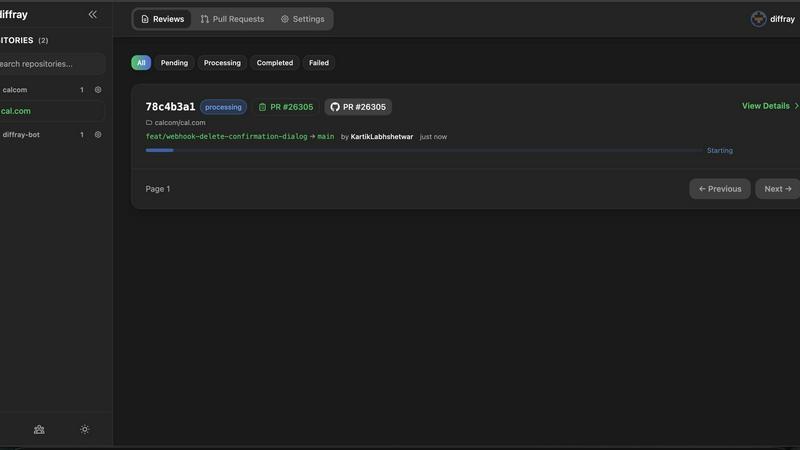
Say goodbye to code chaos with diffray, your AI buddy that spots real bugs without the cringe of false alarms.
Last updated: February 28, 2026

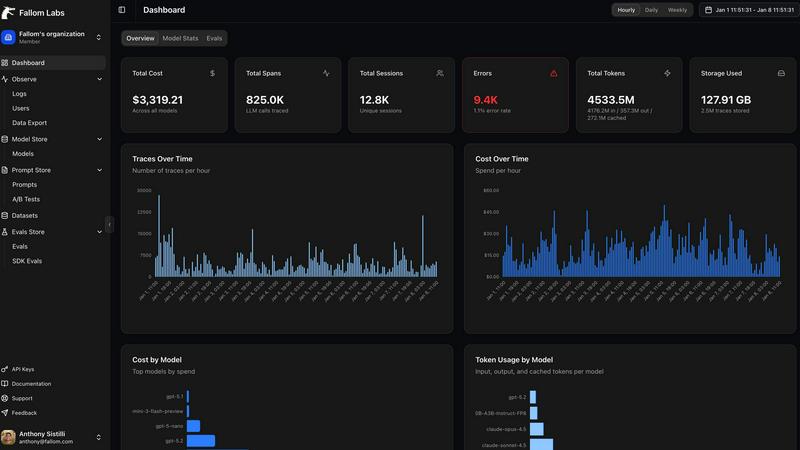
Fallom is your AI's sidekick, giving you real-time visibility into every LLM call and cost.
Last updated: February 28, 2026
Visual Comparison
diffray
Fallom
Feature Comparison
diffray
Smart Issue Detection
With diffray, you get the power of over 30 specialized agents working tirelessly to catch issues that matter. Whether it's a sneaky bug or a major security flaw, this tool is designed to provide actionable insights that help you fix problems efficiently.
Lightning-Fast Reviews
Why waste time? diffray slashes your PR review times from 45 minutes to just 12. This means you can focus on coding and shipping features instead of getting bogged down by lengthy review processes.
Low False Positives
Tired of sifting through irrelevant comments? diffray boasts an impressive reduction of 87% in false positives. This means you can trust the feedback you receive, allowing for a smoother and more productive development experience.
Free for Open Source
If you’re working on open-source projects, good news! diffray offers its powerful code review capabilities for free. This means you can elevate the quality of your open-source contributions without any financial burden.
Fallom
End-to-End LLM Call Tracing
Get the full, unedited story of every interaction. Fallom captures the complete lifecycle of each LLM call, showing you the exact prompt that went in, the response that came out, any tool or function calls the agent made (with arguments and results), token counts, latency at every step, and the calculated cost. It's like having a DVR for your AI, so you can replay any moment to see what really happened when that customer got a bizarre answer.
Real-Time Cost Attribution & Dashboards
Stop the budget panic. Fallom breaks down your AI spending in real-time, showing you costs per model, per user, per team, or per customer. The live dashboard gives you an at-a-glance view of usage and spend, so you can spot a runaway agent or an unexpectedly expensive model before your CFO spots it on the bill. Allocate costs, set up chargebacks, and optimize for efficiency without the spreadsheet nightmares.
Enterprise Compliance & Privacy Controls
Built for the real world where rules matter. Fallom comes packed with features to keep you compliant and secure. That includes full, immutable audit trails for every LLM interaction, detailed input/output logging, model version tracking, and user consent records. Need to handle sensitive data? Flip on Privacy Mode to redact content or log only metadata, keeping your telemetry without capturing confidential info.
Session & User-Level Context Grouping
Debug with the full picture, not just isolated errors. Fallom automatically groups traces by user, session, or customer. This means you can see everything a specific user did in one flow—from their initial question through all the agent's tool calls and LLM hops—making it infinitely easier to understand complex issues and reproduce bugs. It turns a pile of random traces into a coherent user story.
Use Cases
diffray
Speeding Up Code Reviews
Dev teams can dramatically reduce the time they spend on code reviews. With diffray, what used to take 45 minutes can now be done in just 12, allowing your team to focus on what truly matters—building awesome software.
Enhancing Code Quality
Whether you're a solo developer or part of a large team, diffray enhances code quality by catching bugs and security issues before they become bigger problems. It's like having a safety net that ensures your code is top-notch.
Streamlining Open Source Contributions
For open-source contributors, diffray is a game-changer. It helps you catch issues quickly so you can submit well-reviewed code, making your contributions stand out and increasing the chances of acceptance.
Improving Team Collaboration
With diffray's precise feedback, team members can collaborate more effectively. Developers spend less time debating issues and more time implementing solutions, fostering a culture of teamwork and efficiency.
Fallom
Debugging Complex AI Agent Workflows
When your multi-step agent gets stuck or gives a nonsense answer, finding the root cause is a needle-in-a-haystack problem. With Fallom's timing waterfall and tool call visibility, you can instantly see which step in the chain (e.g., an LLM call, a database query, a function) failed or was too slow. You get the full context to squash bugs fast and keep your users happy.
Controlling and Optimizing AI Spend
AI costs can spiral faster than a meme coin. Teams use Fallom to get crystal-clear visibility into which features, models, or customers are driving their API bills. By tracking cost per model and per team, you can make data-driven decisions to optimize prompts, switch models for certain tasks, or implement usage quotas, directly protecting your bottom line.
Ensuring Compliance for Regulated Industries
If you're in finance, healthcare, or any field with strict regulations, deploying AI can be scary. Fallom acts as your compliance co-pilot, automatically generating the detailed audit trails, consent records, and model lineage reports you need to prove adherence to standards like SOC 2, GDPR, or the EU AI Act during audits.
Monitoring Production Performance & Reliability
You can't improve what you can't measure. Fallom's real-time dashboard and live tracing let you monitor the health and performance of your AI features in production. Spot latency spikes, track accuracy metrics with built-in evals, and perform safe A/B tests on new models or prompts—all to ensure a smooth, reliable experience for your end-users.
Overview
About diffray
Say hello to diffray, the game-changer in the world of AI code reviews. This isn’t just another tool that bombards you with noise and irrelevant comments on your pull requests. Nah, diffray is like your personal squad of over 30 specialized agents, each one a mini-expert laser-focused on specific coding areas such as security, performance, bugs, and best practices. Developers are finally getting the clarity they deserve, ditching the generic advice that often leaves them scratching their heads. Imagine slashing your code review time from a stressful 45 minutes to just 12! That’s right, diffray's super-efficient system catches three times more real issues while reducing false positives by an impressive 87%. It’s the ultimate sidekick for teams eager to boost their code quality without the usual hassle. And guess what? If you're into open-source projects, you can take diffray for a spin at no cost! Private repos can also dive in with a sweet 14-day trial. Time to level up your coding game!
About Fallom
Alright, let's break it down. Fallom is like the ultimate control room for your AI chaos. If you're building with LLMs or AI agents, you know the vibe: stuff works in dev, then you ship to production and suddenly it's a black box of mystery calls, weird latencies, and surprise bills from OpenAI. Fallom fixes that. It's an AI-native observability platform built from the ground up to give you X-ray vision into every single LLM call happening in your apps. We're talking full end-to-end tracing that shows you the prompts, the outputs, the tool calls, the tokens, the latency, and even the exact per-call cost. It's designed for devs, product managers, and data science teams who are tired of flying blind and need a single source of truth for their AI ops. With a slick dashboard that serves up context by session, user, or customer, you can debug weird agent behavior in seconds, monitor live usage, and see exactly who or what is burning through your API budget. Plus, it's built on OpenTelemetry, so you can instrument your stack in, like, five minutes flat. And for the enterprise crowd sweating compliance? Fallom's got your back with audit trails, logging, model versioning, and consent tracking to keep you chill with regulations like GDPR and the EU AI Act. In short, it's your wingman for building reliable, cost-controlled, and high-performance AI applications.
Frequently Asked Questions
diffray FAQ
What makes diffray different from other code review tools?
Unlike traditional tools that provide generic feedback, diffray uses specialized agents to offer targeted insights. This means you get actionable advice tailored to specific areas of your code, making reviews way more effective.
Can diffray be used for open-source projects?
Absolutely! diffray is free for open-source projects, making it an excellent choice for developers looking to improve their contributions without any costs.
How does diffray reduce false positives?
With its squad of specialized agents, diffray focuses on key issues relevant to your codebase. This targeted approach significantly cuts down on irrelevant comments, resulting in an impressive reduction in false positives.
Is there a trial period for private repositories?
Yes! Private repositories can kick off with a 14-day trial of diffray. It’s the perfect way to test out its powerful features and see how it can transform your code review process.
Fallom FAQ
How difficult is it to integrate Fallom into my existing app?
It's stupid easy. Fallom is built on the OpenTelemetry standard, so you just install one lightweight SDK. The website boasts you can get "OTEL Tracing in Under 5 Minutes." You add a few lines of code, and it automatically starts capturing traces from your LLM calls, regardless of whether you use OpenAI, Anthropic, Google, or others. No major refactoring needed.
Does Fallom store all my prompt and response data?
You have control. Fallom is designed to capture the full telemetry for observability. However, for sensitive applications, you can enable "Privacy Mode." This lets you redact specific data or run in a metadata-only logging configuration, where you still get all the timing, cost, and structural info without storing the actual content of prompts and responses.
Can I use Fallom to compare different LLM models?
Absolutely! Fallom is built for this. The platform lets you run A/B tests by splitting traffic between different models (like GPT-4o and Claude 3.5). You can then compare their performance side-by-side in the dashboard—looking at cost, latency, and even custom evaluation scores—to make informed decisions about which model to use for each task.
What if my team is small and just starting with AI?
Fallom is for you, too. The platform offers a free tier to get started, which is perfect for small teams or projects. You can start tracing your agents, see costs, and debug issues without an upfront commitment. It scales with you, so as your AI usage grows into enterprise-level, the compliance and advanced features are already there.
Alternatives
diffray Alternatives
Meet diffray, your go-to AI code reviewer that’s all about cutting down on the noise and focusing on what really matters in your code. It’s in the development category, designed to help coders find real bugs with way fewer false positives. Users often seek alternatives to diffray for various reasons, like pricing, specific feature sets, or the need for compatibility with certain platforms. When searching for a suitable replacement, it’s crucial to consider factors like the tool’s accuracy, user experience, and the extent of features that align with your team's specific needs. As the tech landscape continues to evolve, finding an AI code review tool that fits your workflow can be a game-changer. Whether you're part of a big team or working solo, the right alternative can help streamline your review process and enhance code quality. Keep an eye out for tools that offer specialized feedback, ease of integration, and a solid reputation in the developer community to ensure you're making a smart choice.
Fallom Alternatives
So you're vibing with Fallom, the AI observability platform that's basically a crystal ball for your LLMs and agents. It's the go-to dev tool for teams who need to track every API call, debug weird outputs, and stop their cloud bill from going absolutely viral. It's a whole mood for managing AI ops. But let's keep it a buck, sometimes the fit isn't perfect. Maybe the pricing feels a bit extra for your startup grind, or you're locked into a specific cloud ecosystem and need a native tool. Other times, you might just crave a different UI flavor or need a hyper-specific feature that's not in the current stack. It's all about finding your app's soulmate. When you're scrolling through options, don't just look at the shiny features. Peep the integration game—how easy is it to actually plug and play? Check the transparency on pricing (no one likes surprise invoices). And most importantly, see if it scales with your vibe, from your solo developer era to a full enterprise glow-up. The goal is to keep your AI smooth, monitored, and budget-friendly.