
Fallom vs HookMesh
Side-by-side comparison to help you choose the right AI tool.

Fallom is your AI's sidekick, giving you real-time visibility into every LLM call and cost.
Last updated: February 28, 2026

HookMesh makes webhook delivery a breeze with reliable retries and a self-serve portal, so you can chill while we.
Last updated: February 28, 2026
Visual Comparison
Fallom
HookMesh
Feature Comparison
Fallom
End-to-End LLM Call Tracing
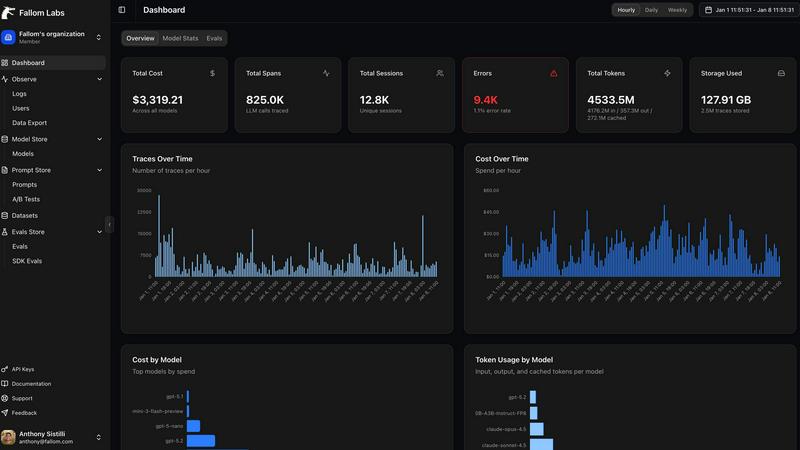
Get the full, unedited story of every interaction. Fallom captures the complete lifecycle of each LLM call, showing you the exact prompt that went in, the response that came out, any tool or function calls the agent made (with arguments and results), token counts, latency at every step, and the calculated cost. It's like having a DVR for your AI, so you can replay any moment to see what really happened when that customer got a bizarre answer.
Real-Time Cost Attribution & Dashboards
Stop the budget panic. Fallom breaks down your AI spending in real-time, showing you costs per model, per user, per team, or per customer. The live dashboard gives you an at-a-glance view of usage and spend, so you can spot a runaway agent or an unexpectedly expensive model before your CFO spots it on the bill. Allocate costs, set up chargebacks, and optimize for efficiency without the spreadsheet nightmares.
Enterprise Compliance & Privacy Controls
Built for the real world where rules matter. Fallom comes packed with features to keep you compliant and secure. That includes full, immutable audit trails for every LLM interaction, detailed input/output logging, model version tracking, and user consent records. Need to handle sensitive data? Flip on Privacy Mode to redact content or log only metadata, keeping your telemetry without capturing confidential info.
Session & User-Level Context Grouping
Debug with the full picture, not just isolated errors. Fallom automatically groups traces by user, session, or customer. This means you can see everything a specific user did in one flow—from their initial question through all the agent's tool calls and LLM hops—making it infinitely easier to understand complex issues and reproduce bugs. It turns a pile of random traces into a coherent user story.
HookMesh
Reliable Delivery
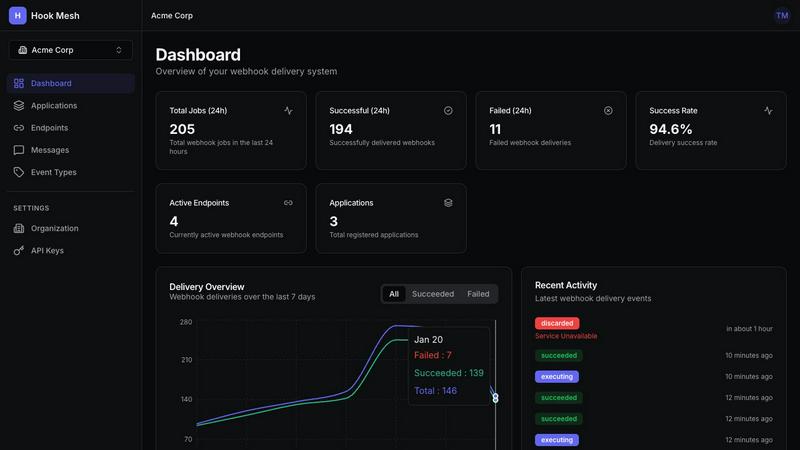
Never lose a webhook again! HookMesh guarantees reliable delivery with automatic retries, exponential backoff, and circuit breakers that auto-disable failing endpoints. This feature ensures your webhook events get where they need to be, even if it takes a few tries.
Customer Portal
Your customers get a self-service experience with an embeddable UI that makes endpoint management a breeze. They can view delivery logs, manage their endpoints, and even replay failed webhooks with just one click. Bye-bye, complicated setups!
Developer Experience
Ship webhooks in minutes with our super-friendly REST API and SDKs for JavaScript, Python, and Go. Integration is as easy as a few code lines, letting you get back to focusing on your core product instead of webhook headaches.
Full Transparency
With HookMesh, you’ll never be left in the dark. Enjoy full request/response visibility through delivery logs that make debugging a walk in the park. No more digging through logs for hours; everything you need is right at your fingertips!
Use Cases
Fallom
Debugging Complex AI Agent Workflows
When your multi-step agent gets stuck or gives a nonsense answer, finding the root cause is a needle-in-a-haystack problem. With Fallom's timing waterfall and tool call visibility, you can instantly see which step in the chain (e.g., an LLM call, a database query, a function) failed or was too slow. You get the full context to squash bugs fast and keep your users happy.
Controlling and Optimizing AI Spend
AI costs can spiral faster than a meme coin. Teams use Fallom to get crystal-clear visibility into which features, models, or customers are driving their API bills. By tracking cost per model and per team, you can make data-driven decisions to optimize prompts, switch models for certain tasks, or implement usage quotas, directly protecting your bottom line.
Ensuring Compliance for Regulated Industries
If you're in finance, healthcare, or any field with strict regulations, deploying AI can be scary. Fallom acts as your compliance co-pilot, automatically generating the detailed audit trails, consent records, and model lineage reports you need to prove adherence to standards like SOC 2, GDPR, or the EU AI Act during audits.
Monitoring Production Performance & Reliability
You can't improve what you can't measure. Fallom's real-time dashboard and live tracing let you monitor the health and performance of your AI features in production. Spot latency spikes, track accuracy metrics with built-in evals, and perform safe A/B tests on new models or prompts—all to ensure a smooth, reliable experience for your end-users.
HookMesh
E-commerce Tracking
HookMesh is perfect for e-commerce platforms that need to send order updates to customers in real-time. With reliable webhook delivery, you can keep customers updated on their orders without worrying about lost notifications.
SaaS Application Events
For SaaS products that need to notify users of important events like account changes or feature releases, HookMesh provides a seamless way to deliver these updates reliably and efficiently.
Payment Processing Notifications
Payment gateways can rely on HookMesh to send instant payment notifications to users. With automatic retries and delivery logs, you can ensure that every transaction gets communicated without any hiccups.
Third-party Integrations
If your app needs to hook into third-party services, HookMesh makes it easy to send and receive webhook events. With its robust infrastructure, you can rely on smooth communication between your app and external services.
Overview
About Fallom
Alright, let's break it down. Fallom is like the ultimate control room for your AI chaos. If you're building with LLMs or AI agents, you know the vibe: stuff works in dev, then you ship to production and suddenly it's a black box of mystery calls, weird latencies, and surprise bills from OpenAI. Fallom fixes that. It's an AI-native observability platform built from the ground up to give you X-ray vision into every single LLM call happening in your apps. We're talking full end-to-end tracing that shows you the prompts, the outputs, the tool calls, the tokens, the latency, and even the exact per-call cost. It's designed for devs, product managers, and data science teams who are tired of flying blind and need a single source of truth for their AI ops. With a slick dashboard that serves up context by session, user, or customer, you can debug weird agent behavior in seconds, monitor live usage, and see exactly who or what is burning through your API budget. Plus, it's built on OpenTelemetry, so you can instrument your stack in, like, five minutes flat. And for the enterprise crowd sweating compliance? Fallom's got your back with audit trails, logging, model versioning, and consent tracking to keep you chill with regulations like GDPR and the EU AI Act. In short, it's your wingman for building reliable, cost-controlled, and high-performance AI applications.
About HookMesh
HookMesh is your new best buddy when it comes to handling webhooks for your SaaS products. It's crafted to take the headache out of webhook delivery, letting you ditch the stress of building everything in-house. Forget about the endless hours spent coding retry logic, circuit breakers, and debugging delivery issues! With HookMesh, you can focus on what really matters: building awesome products that your customers will love. It’s like having a reliable sidekick that ensures your webhook events are delivered without a hitch. Built for developers and product teams, HookMesh provides a solid foundation that guarantees reliability through automatic retries, exponential backoff, and idempotency keys. Plus, with a sleek self-service portal, your customers can manage endpoints and even replay failed webhooks with a single click. Say goodbye to webhook chaos and hello to smooth, reliable delivery with HookMesh!
Frequently Asked Questions
Fallom FAQ
How difficult is it to integrate Fallom into my existing app?
It's stupid easy. Fallom is built on the OpenTelemetry standard, so you just install one lightweight SDK. The website boasts you can get "OTEL Tracing in Under 5 Minutes." You add a few lines of code, and it automatically starts capturing traces from your LLM calls, regardless of whether you use OpenAI, Anthropic, Google, or others. No major refactoring needed.
Does Fallom store all my prompt and response data?
You have control. Fallom is designed to capture the full telemetry for observability. However, for sensitive applications, you can enable "Privacy Mode." This lets you redact specific data or run in a metadata-only logging configuration, where you still get all the timing, cost, and structural info without storing the actual content of prompts and responses.
Can I use Fallom to compare different LLM models?
Absolutely! Fallom is built for this. The platform lets you run A/B tests by splitting traffic between different models (like GPT-4o and Claude 3.5). You can then compare their performance side-by-side in the dashboard—looking at cost, latency, and even custom evaluation scores—to make informed decisions about which model to use for each task.
What if my team is small and just starting with AI?
Fallom is for you, too. The platform offers a free tier to get started, which is perfect for small teams or projects. You can start tracing your agents, see costs, and debug issues without an upfront commitment. It scales with you, so as your AI usage grows into enterprise-level, the compliance and advanced features are already there.
HookMesh FAQ
How does HookMesh ensure reliable webhook delivery?
HookMesh employs automatic retries, exponential backoff, and circuit breakers to ensure that webhooks are delivered consistently, even in the face of transient failures.
Is there a way for my customers to manage their endpoints?
Absolutely! HookMesh provides a self-service portal that allows your customers to manage their endpoints, view delivery logs, and replay failed webhooks at their convenience.
What programming languages does HookMesh support?
HookMesh offers SDKs for JavaScript, Python, and Go, making it super easy for developers to integrate webhook functionality into their applications.
What happens if a webhook fails to deliver?
In the event of a failure, HookMesh automatically retries delivery for up to 48 hours. Plus, your customers can easily replay failed webhooks through the self-service portal, ensuring nothing is missed.
Alternatives
Fallom Alternatives
So you're vibing with Fallom, the AI observability platform that's basically a crystal ball for your LLMs and agents. It's the go-to dev tool for teams who need to track every API call, debug weird outputs, and stop their cloud bill from going absolutely viral. It's a whole mood for managing AI ops. But let's keep it a buck, sometimes the fit isn't perfect. Maybe the pricing feels a bit extra for your startup grind, or you're locked into a specific cloud ecosystem and need a native tool. Other times, you might just crave a different UI flavor or need a hyper-specific feature that's not in the current stack. It's all about finding your app's soulmate. When you're scrolling through options, don't just look at the shiny features. Peep the integration game—how easy is it to actually plug and play? Check the transparency on pricing (no one likes surprise invoices). And most importantly, see if it scales with your vibe, from your solo developer era to a full enterprise glow-up. The goal is to keep your AI smooth, monitored, and budget-friendly.
HookMesh Alternatives
HookMesh is a sleek tool designed to smooth out the bumpy ride of webhook delivery for SaaS companies. Think of it as your trusty sidekick, handling all the nitty-gritty stuff like retries and debugging so that you can focus on building your killer product. But hey, not everyone finds love at first sight, and some users are on the hunt for alternatives due to factors like pricing, specific feature sets, or the need for platform compatibility that just clicks better with their tech stack. When you’re scoping out alternatives, keep an eye out for key features that matter to your workflow. Look for reliability in delivery, ease of use, and a robust customer experience, because who wants to deal with headaches over webhook management? It's all about finding that sweet spot where the tool meets your needs without breaking the bank or your brain.