

Self-Healing Integrations
Plumbed.io hooks your systems together with AI that auto-fixes issues so you never stress about integrations breaking.
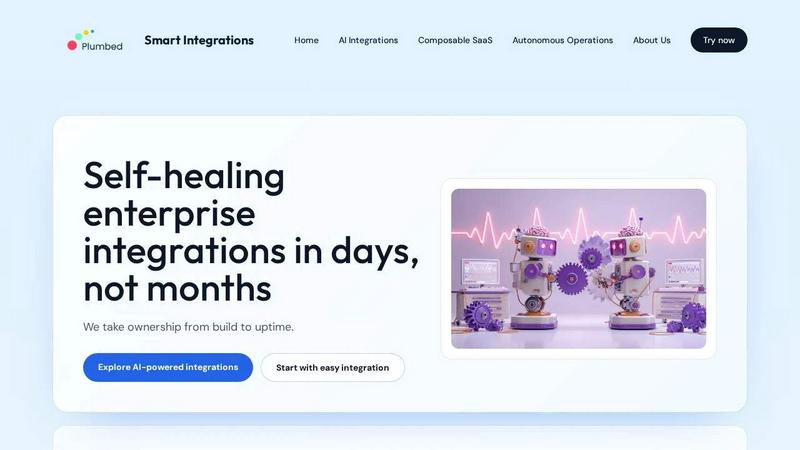
About Self-Healing Integrations
Alright, let’s cut the corporate jargon. You know that sinking feeling when you finally launch a custom integration, high-five your team, and then watch it slowly fall apart because some API changed overnight? Yeah, we’ve all been there. Plumbed.io’s Self-Healing Integrations are basically your new best friend for ditching that headache. This isn’t just another tool that builds a connection and ghosts you. We’re talking about a full-on AI-managed lifecycle that takes ownership from the moment you say “go” to keeping your data flowing forever. Think of it as the ultimate “set it and forget it” for your enterprise systems, but with a brain that actually fixes stuff when things go sideways.
So, what is it exactly? It’s a prompt-driven, production-ready platform that replaces those soul-crushing custom integration projects with an AI that monitors, maintains, and heals itself. You’re no longer paying the “integration tax” every time you want to add a new sales channel, a different CRM, or a fresh logistics partner. Instead of slow, expensive launches and a backlog of maintenance tickets, you get faster deployments and lower costs. This product is for anyone who’s tired of their engineering team being the on-call firefighters for broken data pipes. Whether you’re a mid-market company scaling up or a large enterprise with a spaghetti bowl of systems, Plumbed.io makes sure your integrations stay operational, reliable, and up-to-date without you lifting a finger. It’s basically like having a super-nerdy, always-on robot that lives in your cloud and keeps everything running smooth.
Features of Self-Healing Integrations
AI-Powered Self-Healing Engine
This isn’t just a fancy buzzword. The core of this feature is an intelligent system that constantly monitors your integrations for any hiccups. If an API changes its format, a connection drops, or a data field goes rogue, the AI doesn’t just send you an alert at 3 AM. It automatically analyzes the error, figures out the fix, and applies it without any manual intervention. It’s like having a mechanic who lives under your hood and fixes the engine while you’re still driving. This means zero downtime, fewer angry emails from your sales team, and a whole lot less stress for your ops folks.
Prompt-Driven Integration Builder
Forget dragging and dropping a million boxes on a confusing canvas. Plumbed.io lets you describe your integration in plain English (or any language you vibe with). Just type something like “sync all new orders from Shopify to NetSuite every hour,” and the AI translates that prompt into a fully functional, production-ready workflow. It’s as simple as chatting with a super-smart colleague. This feature slashes the time it takes to build new connections from weeks to literally days, making it a total game-changer for teams that need to move fast without hiring a whole army of developers.
Automated Integration Lifecycle Management
Most tools just build the bridge and then peace out. Plumbed.io stays for the whole ride. This feature covers the entire lifecycle from deployment to ongoing maintenance. It automatically handles version updates, dependency checks, and even proactive error handling. So when a third-party system decides to roll out a major update, your integration doesn’t break. It adapts. This eliminates the operational overhead that usually balloons as you add more connections. You don’t have to worry about “tech debt” piling up because the AI is constantly cleaning house and keeping your integrations fresh.
Real-Time Monitoring and Proactive Alerts
You get a crystal-clear dashboard that shows you the health of every single integration in your stack. But here’s the kicker: it doesn’t just show you problems after they happen. The system uses predictive analytics to spot potential issues before they become full-blown outages. It’ll alert you with a casual “hey, this API endpoint is looking a bit shaky, I’m prepping a fix” kind of vibe. This proactive approach means your data pipelines stay solid, and you can actually sleep at night knowing your business operations aren’t going to implode because of a random server glitch.
Use Cases of Self-Healing Integrations
E-commerce and ERP Sync for Retailers
Imagine you’re running a hot DTC brand selling on Shopify, Amazon, and your own site. Keeping inventory, orders, and customer data synced with your ERP (like NetSuite or SAP) is a nightmare. One typo in a mapping and you’re overselling stock. With Plumbed.io, you can build a self-healing integration that automatically syncs orders and inventory in real-time. If Amazon changes their API format, the AI fixes the connection instantly. You never have to manually reconcile data or deal with angry customers who got a “sorry, item out of stock” email after they paid.
CRM and Marketing Automation Alignment
Your sales team lives in Salesforce, but your marketing squad is all about HubSpot. Keeping leads, deal stages, and campaign data in sync is a constant battle. Instead of hiring a consultant to write custom scripts that break every quarter, use Plumbed.io to create a prompt-driven integration. Tell it to “sync all high-value leads from HubSpot to Salesforce with their last touchpoint.” The AI maintains the connection, handles field mapping changes, and ensures your sales team always has the freshest data to close deals, all while you kick back.
Financial Data Pipelines for Fintech
Fintech companies can’t afford downtime. If your integration between your core banking platform and your analytics tool breaks, you’re looking at compliance risks and bad decisions. Plumbed.io’s self-healing capabilities are perfect here. You can set up a pipeline that pulls transaction data, reconciles it, and pushes it to your data warehouse. The AI monitors for schema changes or connection drops and fixes them immediately. This ensures your financial reporting is always accurate and your auditors don’t come knocking with pitchforks.
Multi-Channel Logistics and Fulfillment
If you’re a logistics company or a brand that uses multiple 3PLs (think ShipBob, Flexport, and a local warehouse), keeping shipping statuses and tracking numbers in sync is brutal. One system goes down and your customer support team gets flooded. With Plumbed.io, you build a single, self-healing integration that listens to all your fulfillment partners. When a tracking API changes, the AI patches it up. Your customers get real-time updates, your ops team stops pulling their hair out, and you save a ton on manual data entry costs.
Frequently Asked Questions
How is this different from traditional iPaaS tools like MuleSoft or Workato?
Great question. Traditional iPaaS tools are like giving you a toolbox and a manual. You still have to build, monitor, and fix everything yourself. Plumbed.io is like having a master plumber who not only builds the pipes but also lives in your basement to fix leaks instantly. We use an AI-managed lifecycle that automates maintenance and self-healing, so you don’t need a dedicated team of integration engineers just to keep things running. It’s way less overhead and way more chill.
Do I need a developer to use Plumbed.io?
Nope, not really. While developers will love the control, our prompt-driven interface is designed for anyone who can describe what they want. You can literally type “connect my Stripe payments to QuickBooks” and the AI handles the heavy lifting. It’s built for operations managers, product folks, and even non-technical founders who just want their data to flow without learning a new programming language. Of course, if you want to tweak things, you can, but you don’t have to.
What happens if an API I’m connected to changes?
This is where the self-healing magic kicks in. The AI constantly monitors the endpoints for any changes to their structure or behavior. If it detects a breaking change, it doesn’t just throw an error. It analyzes the new schema, maps it to your existing data flow, and applies a fix automatically. In most cases, you won’t even know it happened. We handle the chaos so your business operations stay smooth and uninterrupted.
How long does it take to get started with a new integration?
We’re talking days, not months. Because you can build integrations using simple prompts, the setup time is drastically reduced. Most standard connections (like CRM to ERP or e-commerce to accounting) can be live in under a week. Complex enterprise stuff might take a bit longer, but we’re still talking a fraction of the time it would take to build custom code or configure a traditional iPaaS. You can literally start with an easy integration in about three minutes.
Pricing of Self-Healing Integrations
(No pricing information was provided in the context, so this section is omitted entirely.)
Explore more in this category:
Similar to Self-Healing Integrations


amaze.directory
A directory of AI tools where a person used each one first.

Speechyou
AI transcription for voice notes, meetings, and audio files in 1,700 languages, with AI summaries and subtitle export and unlimited chat ai usage.

ProspectHalo
AI sales agent that finds qualified leads, runs outreach, follows up automatically, creates content, and helps book more meetings.

benchmark.directory
An AI tools directory that turns down money. 146 listings, 20 categories, no sponsored placement and no affiliate ordering.

connect machine
ConnectMachine is a privacy-first, AI-powered contact management platform designed to solve the critical flaw of modern professional networking