

StockFit API
StockFit API serves up clean SEC data that's actually ready for modeling, backtesting, and valuation without the usual accounting headache.
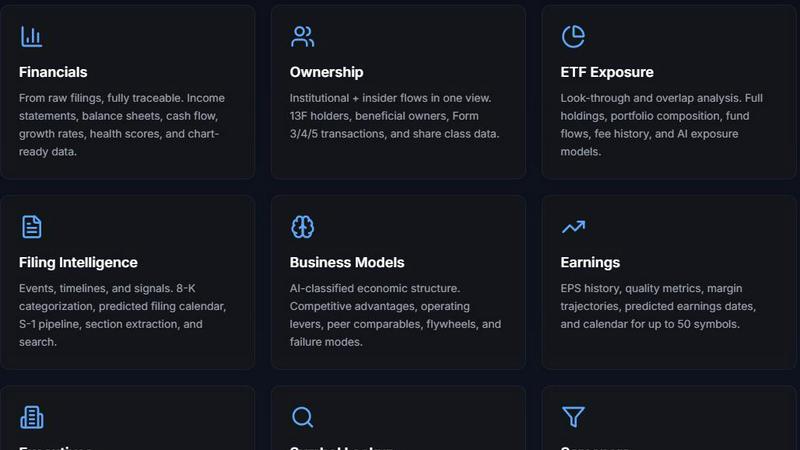
About StockFit API
StockFit API is basically the cheat code developers, quants, and research platforms have been waiting for when it comes to SEC filing data. No more choosing between cheap tiers that give you garbage data or enterprise contracts that drain your startup's entire budget like a black hole. StockFit fills that awkward gap in the market by giving you direct access to SEC XBRL data straight from the source, no sketchy middle layer that messes with the numbers. Every single fact you pull is traceable back to the original filing, so you can actually sleep at night knowing your models aren't built on lies. We're talking fundamentals, ownership data, ETF and mutual fund exposure, insider transactions, and filings all pulled directly from the SEC. The API handles all the messy stuff that other APIs just ignore, like amended filings, non-December fiscal years computed correctly, and Q4 data reconstructed from 10-K plus 10-Q filings. Plus, you get rich economic models per company covering offerings, peers, operating levers, competitive advantages, flywheels, strategic initiatives, and failure modes. The ETF/MF exposure models are next level too, covering mandate, portfolio construction, costs, sensitivities, and use cases that are AI-friendly for LLM workflows. With over 250 million facts and 5 million filings updated daily, you get a REST API plus a native MCP server that works with Claude, Cursor, and other AI tools. This is financial data you can actually model with, no cap.
Features of StockFit API
Standardized Financials with No Taxonomy Drift
Forget about dealing with different accounting taxonomies that break your models every quarter. StockFit standardizes all financial data so you get consistent revenue, expenses, net income, and other key metrics across every company and every period. No more waking up to find your backtesting pipeline is broken because some company changed their reporting format. The API handles all that nonsense behind the scenes, giving you clean, model-ready data every single time. You can pull income statements, balance sheets, cash flow statements, and more with the confidence that the numbers are comparable across different companies and time periods. This is huge for anyone running automated trading strategies or building valuation models that need consistent inputs.
Direct SEC XBRL Data with Source Traceability
Every single data point in StockFit comes straight from SEC XBRL filings, no middleman, no data aggregator that might introduce errors or rounding issues. Each fact includes a source identifier that links back to the original filing, so you can literally verify every number yourself. This is a game changer for quants and researchers who need to audit their data or explain their methodology to stakeholders. No more wondering if that revenue number is accurate or if someone in the data pipeline accidentally shifted a decimal point. You get the raw truth, straight from the source, with full transparency about where each number came from and which filing it belongs to.
Intelligent Fiscal Period Handling
StockFit doesn't just blindly grab numbers and call it a day. The API intelligently handles all the weird edge cases that make financial data a nightmare. Amended filings? Handled. Non-December fiscal years? Computed correctly. Q4 data that needs to be reconstructed from 10-K and 10-Q filings? Done automatically. This means you don't have to write a bunch of custom logic to deal with companies that have weird fiscal calendars or that file amendments to previous reports. The API does all that heavy lifting for you, giving you clean, consistent period data that actually makes sense for your models.
Rich Economic and Exposure Models
StockFit goes way beyond just raw financial data. Each company gets rich economic models covering their offerings, peer comparisons, operating levers, competitive advantages, flywheels, strategic initiatives, and even failure modes. For ETF and mutual fund exposure, you get detailed models covering mandate, portfolio construction, costs, sensitivities, and use cases. These models are specifically designed to be AI-friendly for LLM workflows, meaning you can feed them directly into your machine learning pipelines or GPT-based applications without having to do a ton of preprocessing. It's like getting a full research report baked into your API response.
Use Cases of StockFit API
Automated Quantitative Trading Strategies
Quants can use StockFit to build and backtest trading strategies that rely on fundamental data without worrying about data quality issues. The standardized financials and intelligent period handling mean your backtests actually reflect real market conditions, not garbage data. You can pull updated data daily to keep your models current and make real-time trading decisions based on the latest SEC filings. The source traceability also helps when you need to explain your strategy to compliance or investors.
AI-Powered Financial Research and Analysis
LLM developers and researchers can feed StockFit data directly into their models for financial analysis, report generation, or investment research. The economic models and exposure data are already formatted to work well with AI tools, saving you hours of data cleaning and preprocessing. You can build chatbots that answer questions about company fundamentals, create automated research reports, or develop AI analysts that can discuss a company's competitive position and strategic initiatives.
Portfolio Management and Risk Analysis
Asset managers and wealth advisors can use StockFit to get detailed exposure data for ETFs and mutual funds, helping them understand exactly what their clients are invested in. The ownership data shows who holds what, making it easy to track institutional interest and insider trading activity. The failure mode models help identify potential risks in a portfolio before they become problems, giving you a heads up on companies that might be heading for trouble.
Valuation and Financial Modeling
Investment bankers, analysts, and finance students can use StockFit to build discounted cash flow models, comparable company analyses, and other valuation frameworks. The standardized financials make it easy to pull historical data and project future performance, while the economic models give you context about a company's competitive advantages and growth drivers. The source traceability means you can cite your data sources directly in your models and reports.
Frequently Asked Questions
How does StockFit handle amended SEC filings?
StockFit automatically detects when a company files an amendment to a previous report and updates the data accordingly. You don't have to do anything special or write any extra code. The API just gives you the most current, accurate data based on the latest filings. If you need to track changes over time, the source identifiers let you see which version of the data came from which filing.
What companies and time periods does StockFit cover?
StockFit covers all companies that file with the SEC, including US-listed stocks, foreign private issuers, and other reporting entities. The database includes over 250 million facts from 5 million filings, with data going back as far as the SEC's XBRL program allows. New filings are added daily, so you always have access to the most recent data.
Can I use StockFit with AI tools like Claude or Cursor?
Absolutely. StockFit includes a native MCP server that works directly with Claude, Cursor, and other AI tools that support the Model Context Protocol. This means you can query financial data using natural language and get structured responses that your AI tools can process immediately. No need to build custom integrations or write complex API calls.
How accurate is the data and how do I verify it?
Every data point in StockFit comes directly from SEC XBRL filings with no derived middle layer that could introduce errors. Each fact includes a source identifier that links back to the original filing document, so you can verify any number yourself by checking the SEC's EDGAR system. This is as close to ground truth as you can get without manually reading every filing yourself.
Pricing of StockFit API
StockFit offers a free tier that gives you immediate access to the API with daily usage limits, perfect for testing and small projects. For serious development and production use, there are paid tiers that scale with your data needs. The pricing is designed to be affordable for startups and individual developers, not just enterprise customers with massive budgets. You can get started with a free API key right now and upgrade as your usage grows. Check the pricing page on the StockFit website for the latest plans and costs.
Explore more in this category:
Similar to StockFit API


Hishab
All-in-one POS, inventory, accounting and HR software for Bangladeshi SMEs — real-time sales, stock and finance in one place.


